
Research Interest
Continuous gravitational wave from compact objects
-
White Dwarfs (WDs) are end state of main sequence star with mass less than 10 solar mass, and held against gravity by electron degeneracy pressure. Neutron stars (NSs) are remnants of Type II supernovae from 10 to 20 solar mass stars, after the nuclear fuel exhaustion.
-
Detection of such compact objects always remains of a great interest. The NSs with electromagnetic radiation can be detected as Pulsars. NSs in binary system can be detected as X-ray source and/or Gravitational Wave (GW) sources. Similarly WDs can be detected as Cataclysmic Variables in binary system, and also can be detected indirectly via Type Ia Supernova, when the Chandrasekhar mass limit is exceeded due to accreting matter.
-
Isolated NSs (not in binary system or with negligible electromagnetic radiation) has tiny size and no source of thermal energy, and thus lowly luminous. Isolated magnetized WDs are also thermally lowly luminous and thus difficult to detect in electromagnetic (EM) surveys, such as SDSS, Kepler, Gaia.
-
Then, How to Detect ‘Isolated’ or ‘Invisible’ NSs and WDs directly?
-
The event of several black hole (BH) and NS mergers detected by LIGO-VIRGO has confirmed directly the existence of gravitational wave (GW), which is one of the consequences of Einstein’s general theory of relativity (Abbott et. al., 2016).
-
On the other hand, a few super-Chandrasekhar white dwarfs WDs) have been inferred through the peak luminosity of peculiar over-luminous type Ia (SNeIa) supernovae as a revolutionary discovery in astronomy (Howell et. al., 2006). Similarly, several NSs with mass more than 2 solar mass have been observed (Cromartie et al., 2020).
-
It has already been argued that if such compact objects are highly magnetized and rotating, they can be massive.
-
With magnetic field and rotation axes misaligned, the system becomes triaxial and thus can have time varying non-zero quadrupole moment (essential to generate gravitational wave). Thus the massive compact objects also can emit continuous GW (CGW). [Why “Continuous”?: GW is emitted continuously, as long as star is magnetized and spinning (like a singer holding a single note for a long time).]
-
The CGW can be detected by the upcoming detectors, e.g., Einstein Telescope (ET), Cosmic Explorer (CE), LISA, BBO, etc. The detection of CGW from isolated massive NSs and WDs would be a fundamental breakthrough and a novel endeavor to detect them directly, which can provide us an idea about their spin, internal magnetic field, as well as about the equation of state (EOS).
-
Our aim is to simulate CGW from isolated magnetized rotating NSs and WDs and try to understand observation plausibility.


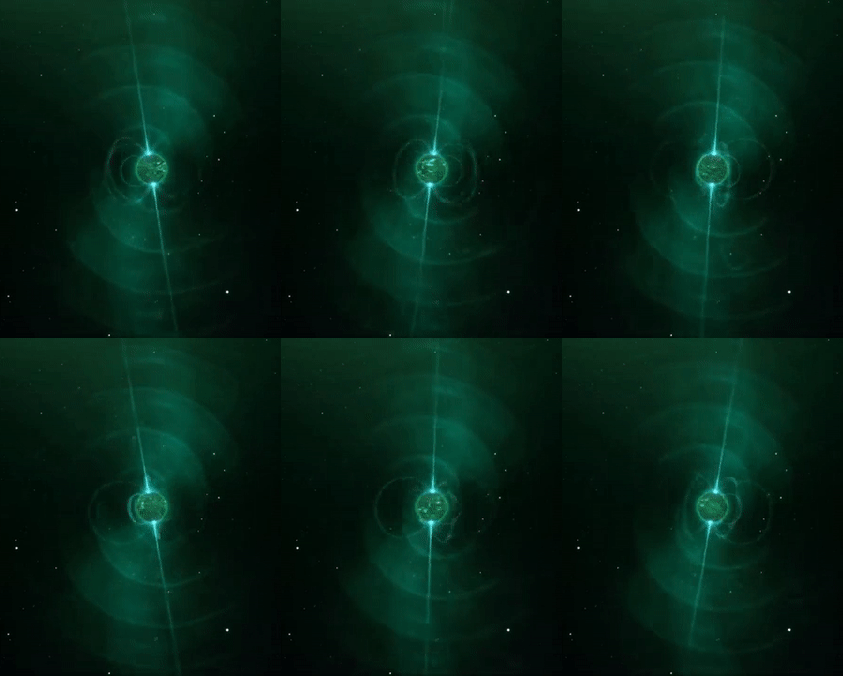
Picture Credit: Continuous Gravitational Waves group of Max Plank institute for Gravitational Physics
Neutron stars (NSs) provide an extraordinary natural laboratory to explore superconductivity and superfluidity under extreme conditions—high density, strong magnetic fields, and ultra-low temperatures. Decades of theoretical work have suggested the presence of these quantum states in NS interiors, and observational hints, such as the rapid cooling of Cassiopeia A, support this idea. Why superconductivity arises in NSs As neutron stars cool below 𝑇 ∼ 10 9 K T∼10 9 K, primarily via neutrino emission from beta decay, the degenerate proton fluid can undergo BCS-type pairing and become superconducting. This occurs in a background of frozen-in magnetic fields, often reaching 𝐵 ∼ 10 15 − 10 16 G B∼10 15 −10 16 G in the core, particularly in magnetars. Unlike lab superconductors (where electrons pair via phonon interactions in a lattice), NSs lack a lattice. Instead, protons form Cooper pairs via the attractive tail of the strong nuclear force. Electrons in NSs remain unpaired due to their ultrarelativistic nature and extremely low 𝑇 𝑐 T c values. The resulting system exhibits finite-temperature superconductivity with 𝑇 / 𝑇 𝐹 ∼ 10 − 3 T/T F ∼10 −3 , inaccessible on Earth. How NS superconductivity differs from terrestrial cases No phonon mediation; pairing is purely nuclear. No lattice structure; hence, field expulsion behaves differently. Extremely high electrical conductivity delays magnetic field expulsion, making Meissner effect non-ideal. Superconductivity can be type-I or type-II, depending on local microphysical parameters and field strength. Two distinct superconducting regimes (see figure) The superconducting behavior depends on the Ginzburg-Landau parameter 𝜅 = 𝜆 / 𝜉 κ=λ/ξ: Type I ( 𝜅 < 1 / 2 κ<1/ 2 ): The magnetic field is ideally expelled (Meissner effect) below 𝐻 𝑐 𝑚 H cm , but in NSs, this process is inefficient. The magnetic field remains trapped or discontinuously distributed in layered domains. Type II ( 𝜅 > 1 / 2 κ>1/ 2 ): The field partially penetrates the superconductor between 𝐻 𝑐 1 H c1 and 𝐻 𝑐 2 H c2 as quantized flux tubes, forming an ordered lattice. These tubes enhance internal magnetic stress and deform the star—key for gravitational wave emission. Key questions our study addresses (see figure): Is the proton superconductor in NSs type I or type II? Where in the star does superconductivity exist—outer core or inner core? What is the geometry of the superconducting regions? Can we observe its effects indirectly, e.g., through gravitational waves? Our contribution We conduct the first 2D general relativistic study of superconductivity in magnetars with toroidal fields, using the XNS code to solve the Einstein-Maxwell equations with: Realistic EOS for nuclear matter, Temperature-dependent proton pairing gaps, Finite magnetic field strengths up to 10 16 G 10 16 G. This enables us to map out type-I, type-II, and non-superconducting zones, including novel torus-shaped normal regions, and track their dependence on stellar mass, field configuration, and thermal evolution. Broader impact Our work has implications for the detectability of continuous gravitational waves from isolated neutron stars. In superconducting NSs, magnetic stresses and resulting ellipticities are significantly enhanced—making gravitational wave strain potentially observable in next-generation detectors. Thus, NS superconductivity may be indirectly confirmed via gravitational wave astronomy.
Superconductivity in magnetized neutron stars and their detection
Why Study Superconductivity in Neutron Stars?
Neutron stars (NSs) are natural cosmic laboratories for studying high temperature superconductivity and superfluidity under extreme conditions—immense density, ultra-strong magnetic fields. Decades of theory and observations, such as the rapid cooling of the Cassiopeia A supernova remnant, suggest the presence of these exotic quantum states inside NSs.
Superconductivity in NSs: How and Why It Happens
As NSs cool below roughly 10⁹ K (via neutrino emission from beta decay), protons in the dense core can pair up and form a superconducting fluid. This happens in the presence of strong, pre-existing magnetic fields that can reach up to 10¹⁶ Gauss in magnetars.
Unlike lab superconductors—where electrons pair via phonon interactions inside a crystal lattice—
neutron stars lack a lattice entirely. Instead, protons pair due to the long-range attraction of the strong nuclear force.
Electrons do not superconduct in NSs, as they are highly relativistic and have critical temperatures far below the star's actual temperature.
A Unique Playground: Superconductivity at Finite Temperature and Extreme Conditions
Neutron stars allow us to study superconductivity in a regime where the temperature is low compared to the Fermi temperature—T divided by TF is about 10⁻³—and the magnetic field is effectively frozen in. These conditions cannot be recreated on Earth.
Two Types of Superconductivity in Neutron Stars
The nature of superconductivity in NSs is governed by the ratio of two physical lengths: the London penetration depth (λ) and the coherence length (ξ). This ratio is called the Ginzburg-Landau parameter, κ = λ/ξ:.
-
Type I Superconductors: If κ<1/2, the magnetic field is ideally expelled below a critical value Hcm because magnetic field decays in London penetration depth (known as the Meissner effect). However, in NSs, the extremely high electrical conductivity makes field expulsion inefficient. The result is trapped magnetic fields or domain-like field structures.
-
Type II Superconductors: If κ>1/2, magnetic fields partially penetrate between two critical values as the coherence length is smaller than the London penetration depth, Hc1 and Hc2, as an ordered array of magnetic flux tubes. These flux tubes increase magnetic stress and deform the star, which can enhance continuous gravitational wave (CGW) emission.
Our Study Asks and Answers Key Questions
-
Is the proton superconductivity in NSs type I or type II?
-
Where do these superconducting regions exist—outer core or inner core?
-
What are their geometric shapes?
-
Can we observe superconductivity indirectly through CGWs?
-
Our Contribution
We present the first 2D general relativistic simulation of superconducting regions in magnetars with toroidal magnetic fields. Using the XNS code, we solve the Einstein-Maxwell equations with realistic nuclear physics and temperature-dependent proton pairing gaps. This allows us to map type-I, type-II, and non-superconducting regions and examine how they evolve with star mass, temperature, and field strength.
Why It Matters
Superconducting regions—especially type-II ones—can strongly enhance magnetic deformation. This increases gravitational wave strain, making it potentially observable with future detectors like Cosmic Explorer. Gravitational wave astronomy may thus offer an indirect window into the hidden superconducting interiors of neutron stars.


