

Publications
1. Mayusree Das and Banibrata Mukhopadhyay, “Detection possibility of continuous gravitational waves from rotating magnetized neutron stars,” The Astrophysical Journal, 955, 19 (2023).
2. Mayusree Das, Armen Sedrakian and Banibrata Mukhopadhyay, “Superconductivity in magnetars: Exploring type-I and type-II states in toroidal magnetic fields,” Physical Review D Letters, 111, L081307 (2025).
3. Mayusree Das, Banibrata Mukhopadhyay and Tomasz Bulik, “Continuous gravitational waves from magnetized white dwarfs: Quantifying the detection plausibility by LISA,” The Astrophysical Journal, 995, 107 (2025).
4. Mayusree Das, Armen Sedrakian and Banibrata Mukhopadhyay, “Topology of the superconducting heart of neutron stars: Effects of microphysics and gravitational-wave signatures,” Physical Review D, 113, 043004 (2026).
5. Mayusree Das and Banibrata Mukhopadhyay, “Plausible detection of rotating magnetized neutron stars by their continuous gravitational waves,” Astronomy Reports, 67 (Suppl. 2), S179–S188 (2023).
6. Prabal Adhikari et al. (including Mayusree Das), “Strongly interacting matter in extreme magnetic fields,” Progress in Particle and Nuclear Physics, 138, 104199 (2025).
7. Zenia Zuraiq, Mayusree Das, Debabrata Deb, Surajit Kalita, Fridolin Weber and Banibrata Mukhopadhyay, “Anisotropic Compact Stars: Theory and Simulation from Microphysical Models to Macroscopic Structure and Observables,” Universe, 12, 130 (2026).
8. Mayusree Das, Tomasz Bulik, Sreeta Roy and Banibrata Mukhopadhyay, “Continuous Gravitational Waves from Supersoft X-ray Sources: Promising Targets for deci-Hz Detectors,” submitted, arXiv:2602.09124.
9. Mayusree Das and Banibrata Mukhopadhyay, “Can we detect super-Chandrasekhar white dwarfs via continuous gravitational waves?,” in The Relativistic Universe: From Classical to Quantum (ISRA 2023), Springer, pp. 355–365 (2025).
My Work
Continuous gravitational wave from compact objects
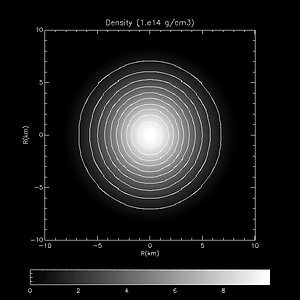
We have explored the existence of massive NSs by simulating magnetized (left: Toroidal or Right: Poloidal geomery), rotating (uniform or differential configuration) NSs by using Einstein equation solver XNS code (Pili et al., 2014). From the 2D axisymmetric cross section of NSs, we can visualize that the magnetic field deforms the star considerably.
A system radiates GW if it has a non-zero time varying quadrupole moment, which is present in binary mergers as well as in isolated magnetized rotating compact objects with misaligned axes. We have studied the plausibility of the detection of such massive compact objects via CGW and their detection timescale. Due to their different frequencies, the detected GWs can be easily distinguished whether the underlying sources are NSs or WDs.
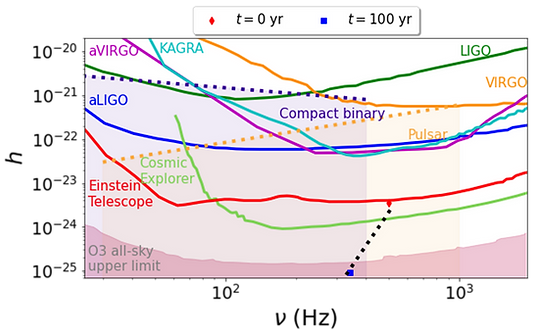
Interestingly, there has been no detection of CGW from NSs in LIGO, VIRGO, aLIGO, and aVIRGO so far (Piccinni et al., 2020).
What can be the reason?
The GW amplitude of rotating magnetized compact objects decays significantly due to various decay mechanisms. The rotational
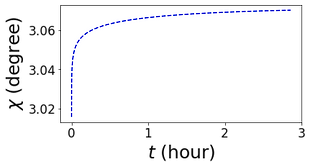
frequency (Ω) and obliquity angle (χ) decay due to the extraction of angular momentum by dipole and quadrupole radiation (in years of timescale depending on field strength and configuration), as shown (Upper left). However, χ can increase (in hours of timescale) very negligibly and then saturate at very early stage of toroidally dominated NS due to viscous and thermal effects, as shown (Upper right). The magnetic field also decays (in thousand years of timescale) due to Ohmic decay, ambipolar diffusion, and Hall drift. Our study shows that GW amplitude decreases rapidly (and mostly) due to the decay of Ω and χ as shown (Lower).
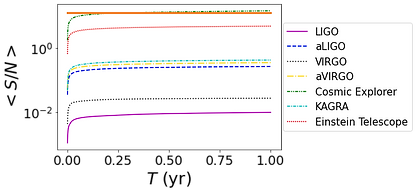
Also, newly born differentially rotating, massive NSs are expected to rapidly settle into uniformly rotating, less massive star in Alfvén timescale (in a couple of seconds) due to magnetic braking (Cook et al., 2003). These suggest that it is essential to investigate such decay timescales, which set a strict upper bound to detect the rotating massive NS by their CGW before they become undetectable due to decay of the GW amplitude decays as displayed (Upper). There is an enormous effort to increase the sensitivity of GW detectors, which can be done by cumulatively adding up the signal-to-noise ratio (SNR) for one year of integrated time. For some models we have seen the NSs which are not detectable immediately by any detectors, after over one year of integration time they will be detectable by some future detectors (Lower).
Importance of the work: We have studied the detectability of CGW from magnetized rotating NS by simulating them and considering all the mechanisms responsible for GW amplitude decay, along with magnetic braking. There were no such exploration considering all the physics before our venture to the best of our knowledge.
Future Objective: Future GW missions e.g. CE and ET should be planned accordingly to detect such massive NSs, which, if detected, can provide us an idea about the spin, magnetic field, as well as EOS and possibly explain “Mass Gap” (2.5M⊙ < M < 5M⊙) between NS and BH masses. (thus the lighter mass of GW190814 merger could be a massive NS)

%20(1).png)





%20(1).png)
Catch me if you can!
Superconductivity in magnetized neutron stars and their detection
Neutron stars (NSs) can host superconducting protons in their dense interiors, forming type-I or type-II phases depending on local field and density. In this work, we construct 2D general relativistic models of magnetars with toroidal magnetic fields using the XNS code, solving Einstein-Maxwell equations with realistic EOS and finite-temperature pairing gaps.
-
We model NSs with M = 1.4 M☉ and 2 M☉, T = 10⁸–4×10⁹ K, and surface B = 10¹⁵–10¹⁶ G.
-
Type-II superconductivity (κ > 1/√2, Hc₁ < H < Hc₂) forms near the crust-core boundary, especially in lower-mass stars.
-
Type-I regions (κ < 1/√2, H < Hcm) appear in deeper cores at low fields.
-
A torus-shaped non-superconducting region emerges where the field is strongest—new in 2D, absent in previous 1D models.
-
Inner core is never superconducting for M ≳ 1.4 M☉ due to high density (ρ > 4.3×10¹⁴ g/cm³).
-
Higher temperature (T = 4×10⁹ K) reduces the superconducting volume, though phase arrangement remains.
-
For M = 1.4 M☉, Bₛₘₐₓ = 3×10¹³ G, we estimate ellipticity ε ≈ 5×10⁻¹⁵ and moment of inertia I ≈ 5×10⁴⁴ g·cm².
-
For MSP PSR J1843–1113, CGW strain becomes h ≈ 10⁻²⁷ for superconducting core vs h ≈ 3×10⁻²⁹ if normal—~100× enhancement.
-
Thus, CGW detection (e.g., by Cosmic Explorer) could indirectly confirm superconductivity and hidden internal fields in magnetars.

Figure: Distribution of the toroidal H-field in the x–y plane (magnetic axis along y), shown for four cases:
Top-left: M = 2 M☉, Bₛ₍ₘₐₓ₎ = 10¹⁶ G, T = 10⁸ K
Top-right: M = 1.4 M☉, Bₛ₍ₘₐₓ₎ = 10¹⁶ G, T = 10⁸ K
Bottom-left: M = 1.4 M☉, Bₛ₍ₘₐₓ₎ = 10¹⁵ G, T = 10⁸ K
Bottom-right: M = 1.4 M☉, Bₛ₍ₘₐₓ₎ = 10¹⁵ G, T = 4×10⁹ K
Red crosses: Type-II superconducting (Hc₁ < H < Hc₂, κ > 1/√2) → fluxtubes
Black dots: Meissner state within type-II (H < Hc₁, κ > 1/√2)
Magenta hatching: Type-I Meissner/layered state (H < Hc₁, κ < 1/√2)
Unhatched: Nonsuperconducting (H > Hcₘ or H > Hc₂)
[Magnetic induction B = 0 when H < Hc₁, but these regions are identified due to possible delayed flux expulsion (Baym et al. 1969).]